
Education
Direct vs. Indirect Detection Strategies in ELISA: What’s the Difference?
ELISA (enzyme-linked immunosorbent assay) is a basic biochemical technique used in laboratories throughout the world. Researchers use this technique to detect and quantify how much of the target proteins are in various samples. There are two main strategies of detection during the implementation of ELISA, direct and indirect. Understanding clearly their definitions, typical workflows and respective pros and cons will allow you to select the best approach for your experimental needs.
What Is Direct ELISA Detection?
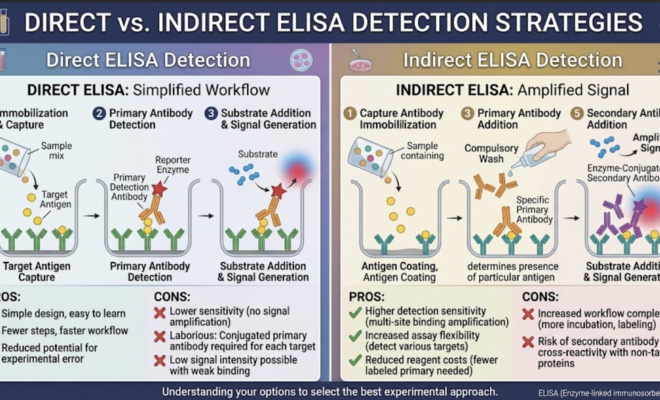
Direct ELISA detection uses a primary antibody immobilized to the solid surface to capture the target protein in the sample mixture. After it has been captured, a secondary antibody conjugated to a reporter enzyme binds to the target. This enzyme then acts to produce a measurable signal which permits accurate quantification of the protein in the sample.
What Is Indirect ELISA Detection?
The indirect ELISA method employs an indirect immunoassay format to determine the presence of a particular antigen. This method depends on a secondary antibody specific to the antigen in question, which is conjugated to an enzyme. When the appropriate substrate is added the enzyme generates a signal for detection. This is unlike a direct ELISA where the primary antibody to the antigen is directly labeled with the enzyme.
What Are The Notable Differences Between Direct and Indirect ELISA Detection Procedures?
Direct and indirect ELISA procedures differ in several important respects. A key difference is how the capture and detection antibodies function in the two formats. In indirect detection the capture antibody is attached to the surface, and it captures the target protein. A specific secondary antibody is directed against the antigen and it indicates the presence of the antigen.
Another fundamental difference is that in indirect detection the secondary antibody is applied and targets the antigen in the sample. The addition of a secondary antibody enables target detection even in the absence of the primary target protein in the sample, a feature that is not available in direct ELISA where detection is strictly dependent on the physical presence of the target protein.
In addition, a wash step is compulsory in indirect ELISA to remove unbound antigens and antibodies from the reaction well. In direct ELISA, this extra wash step is not needed because the enzyme that produces the signal is directly conjugated to the primary antibody and the antigen.
Pros of Direct ELISA Detection
The main advantages of direct detection are:
- The design of the direct ELISA is simple, and thus the process is easy to learn and perform.
- The direct detection workflow usually finishes earlier than the indirect detection workflow.
- The use of a single antibody to both capture and detect the target reduces the number of handling steps and thus reduces the overall experimental error.
Cons of Direct ELISA Detection
However, direct detection has some disadvantages as well as advantages:
- Direct ELISA lacks a signal amplification step and, therefore, has a lower overall sensitivity than indirect methods.
- The requirement to generate a conjugated primary antibody for each different target adds to the overall preparation time and can slow the binding and detection steps.
- Low binding of antibodies to target proteins can lead to lower signal intensity, which decreases accuracy of measurements.
Pros of Indirect ELISA Detection
The indirect detection format has the following advantages:
- Multi-site binding for the interaction of antigen-antibody increases the signal generation and thus provides higher detection sensitivity.
- The use of enzyme-conjugated secondary antibodies allows more flexibility in the design of assays, with the possibility of measuring different targets at the same time.
- This reduces reagent costs and minimizes background interference from non-specific binding, since fewer labeled antibodies are required.
Cons of Indirect ELISA Detection
Potential limitations of indirect detection may include:
- Complexity of workflow increases as additional incubation periods and complicated labeling protocols are introduced compared to direct ELISA.
- Secondary antibodies can cross-react with non-target proteins in the sample, which may affect the accuracy of the results and may take additional time to troubleshoot.
In brief, direct and indirect ELISA are two different ways to explore the target proteins in biological samples, which have their own advantages and disadvantages. Through assessment of the functional properties, advantages and disadvantages of either format you will be able to select the most appropriate detection methodology for your analytical objectives.


0 comments