
Finance
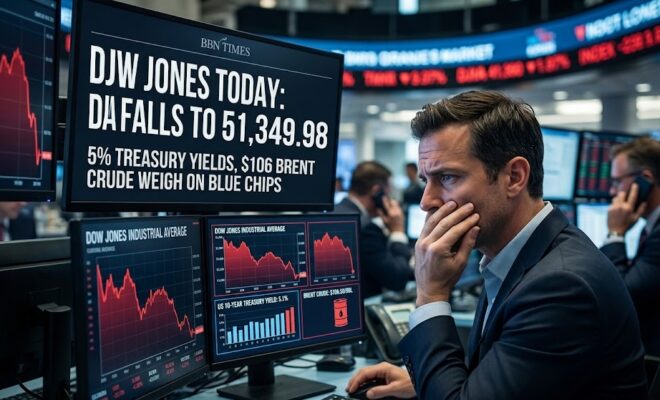
Dow Jones Today: DJIA Falls to 51,349.98 as 5% Treasury Yields and $106 Brent Weigh on Blue Chips
Dow blue-chips extended their losing streak Thursday, paring a morning slide of more than 380 points after reports of US-Iran talks on reopening the Strait of Hormuz but still underperforming the S&P 500 and Nasdaq.
Dow Jones Close Today: 51,349.98, Down 0.31%
Google Finance and Yahoo Finance reported the Dow Jones Industrial Average closed at 51,349.98 on Thursday, 24 September 2026, down 161.61 points or 0.31% from Wednesday’s close of 51,511.59. The index opened at 51,415.75, dropped to a session low of 51,124.02 shortly after 11 am New York time, before rallying to a high of 51,485.97 in the early afternoon.
The Dow was down 352.10 points, or 0.68%, on Wednesday and has fallen more than 500 points in the last two days. The S&P 500 finished almost unchanged and the Nasdaq Composite added a fractional gain, making the S&P the weakest of the three major US averages on the day.
What Caused the Dow to Trail the S&P 500 and Nasdaq?
The price-weighted nature of the Dow means that high-priced industrial and financial names have a big impact on the index, and some of those were struggling as bond yields rose. Goldman Sachs and Caterpillar were down most of the day, a sign of concerns that higher borrowing costs will slow capital spending and deal-making. Meta’s tech rebound didn’t do as much for the Dow, since it’s not a Dow component.
The index also has relatively low exposure to energy stocks that have gained from soaring crude prices. Thus the dip-buying that brought the S&P 500 and Nasdaq back to flat after the Hormuz headline wasn’t as effective in the blue-chip average, which ended well off its lows but still solidly in the red.
What’s Behind the Rise in Treasury Yields?
The 10-year Treasury yield was near 5.1% on Thursday after reaching its highest level since 2007 on Wednesday, and the 30-year yield was at about 5.43%, its highest since 2004. Yields have climbed on an energy-price shock tied to the Iran conflict, better-than-expected US business activity and ongoing hawkish comments from Federal Reserve officials.
New York Fed president John Williams said another hike by year-end would be reasonable and Philadelphia Fed president Anna Paulson said further modest tightening may be required. CME FedWatch data showed about 69% chance of an October hike. But the Treasury’s expanded buyback operation was also a disappointment, Bloomberg said, removing a source of support for long-dated bonds.
Which Economic Data and Corporate News Moved the Dow?
Initial jobless claims dropped by 1,000 to 197,000 in the week ended September 19, below the 201,000 forecast and near historic lows. Continuing claims were 1.72 million. The strong labor data bolstered the Fed’s hawkish stance which weighed on rate-sensitive blue chips.
The Dow was weighed down by MGM Resorts, which fell around 10% after Barry Diller’s People Inc. withdrew its buyout offer, and Darden Restaurants, which declined after missing first-quarter expectations. Investors also watched a Washington summit between US President Donald Trump and Chinese President Xi Jinping, with Treasury Secretary Scott Bessent saying the two sides agreed to extend their trade truce to 10 January.
How far is Dow from 52 week high?
The Dow is trading at 51,349.98, some 6.2% below its 52-week high of 54,744.33, and some 14% above its 52-week low of 45,057.28. That gap is much wider than for the S&P 500 or Nasdaq, which are still within about 1.5% of their highs, highlighting just how far the blue-chip index has lagged the technology-led rally.
Technically, the first level of support to watch is Thursday’s low at roughly 51,124, with the 51,000 level below that. The recent selling has run its course, a close above the level seen on Wednesday of 51,511 would be needed to suggest this. The next resistance is the 52,000 area, last seen earlier in the week.
Dow Jones Investors: What to Watch Next
Costco results due after the bell will provide a taste of consumer spending, while any comments from the Trump-Xi summit can move industrial exporters like Caterpillar and Boeing. Investors will also be eyeing whether the 30-year Treasury yield remains above 5.4%, a level that has become a key pressure point for rate-sensitive blue chips. A decisive break back below the 5% level on the 10-year would give the Dow its best shot to claw back this week’s losses.
Frequently Asked Answers
What was the Dow Jones close on 24 September 2026?
The Dow Jones Industrial Average fell 161.61 points, or 0.31%, to end at 51,349.98.
There’s a reason the Dow fell more than the S&P 500?
The Dow has bigger weights in industrial and financial stocks that are sensitive to rising bond yields, and does not include Meta, which led the tech rebound.
How far is the Dow from its all time high?
The Dow is down about 6.2% to 51,349.98, below its 52-week high of 54,744.33.
At a Glance: Global Markets
In Asia, the Nikkei 225 rose 0.76% to 65,513.99 as it resumed trading after a three-day holiday, the SSE Composite fell 1.22% to around 3,888, the BSE SENSEX was down 1.67% at 73,580.54 and Hong Kong’s Hang Seng Index was down 0.29% at 24,761. South Korea’s markets were closed for a public holiday. Markets in mainland China will be closed Friday for the Mid-Autumn Festival.
Brent crude jumped above $105 a barrel and German 10-year Bund yields hit their highest since 2008, keeping pressure on equities. In Europe, the FTSE 100 fell 0.24% to 10,679.99, the CAC 40 lost 0.52% to 8,081.43, Germany’s DAX 40 dropped 0.57% to 25,266.53 and Milan’s FTSE MIB slid 0.85% to 51,543.45. Wall Street pared earlier losses after a Reuters report that US and Iranian negotiators are working on a phased plan to reopen the Strait of Hormuz. In late-morning trade, the S&P 500 finished essentially flat at 7,704.13 (-0.025%), the Nasdaq Composite edged up 0.012% to 26,939.37 and Canada’s S&P/TSX Composite was down 167.03 points at 35,584.40.
What Investors Should Know
The underperformance of the Dow is an indication that market resilience is concentrated in a small group of technology leaders. Industrial and financial blue chips are more directly exposed to long-term yields above 5% and a slower capital spending cycle. Unless yields pull back or oil prices clearly fall from the Hormuz negotiations, the blue-chip index could continue to lag.


0 comments